

1,000+ Closings 267 Five-Star Reviews FastExpert 2026 Top Agent

Closing Costs in Maricopa AZ: What Buyers and Sellers Pay

Real Broker LLC · Licensed in Arizona

By James Sanson, REALTOR. Licensed Arizona REALTOR since August 2002. Maricopa specialist since 2004. 1,000+ closings across new construction, resale, and distressed-property transactions. See about James Sanson and the team.

Published 2026-05-20. Last reviewed 2026-05-20.

Quick answer

Buyer closing costs in Maricopa, AZ, typically run 2 to 5 percent of the purchase price. Seller closing costs typically run 6 to 10 percent, with the real estate commission as the largest single item. Exact figures depend on price, loan program, title company, HOA, and contract terms. Ask your lender for a Loan Estimate and your title company for a net sheet to see your actual numbers, and call 520-838-8037 for a Maricopa-specific walkthrough.

On this page

  1. Closing costs at a glance: typical ranges
  2. What buyers pay at closing
  3. What sellers pay at closing
  4. Title insurance in Arizona: how it works
  5. Pinal County property tax prorations
  6. HOA transfer fees and capital contributions
  7. Loan-related closing costs (buyer side)
  8. Reducing closing costs on either side
  9. Estimating your closing costs before you sign
  10. When to call a Maricopa real estate professional

If you are buying or selling a home in Maricopa, AZ, closing costs are the line items beyond the purchase price that settle the transaction. Some are loan fees. Some are title and escrow fees. Some are prorations of taxes, HOA dues, and insurance. Some are county recording fees. This page covers what each side typically pays in a Maricopa transaction, where Arizona custom differs from other states, and how to estimate your own numbers before you go under contract.

Closing costs are real money. On a 425,000-dollar Maricopa home, buyer closing costs of 3 percent are roughly 12,750 dollars, and seller costs of 8 percent are roughly 34,000 dollars. Knowing these ranges before you write or accept an offer prevents surprises at the closing table.

This page is informational. Specific tax treatment, deductibility, and legal allocation of costs depend on your situation and on the terms of your purchase contract. For tax questions, consult a CPA or qualified tax professional. For contract or title questions, consult an Arizona-licensed attorney.
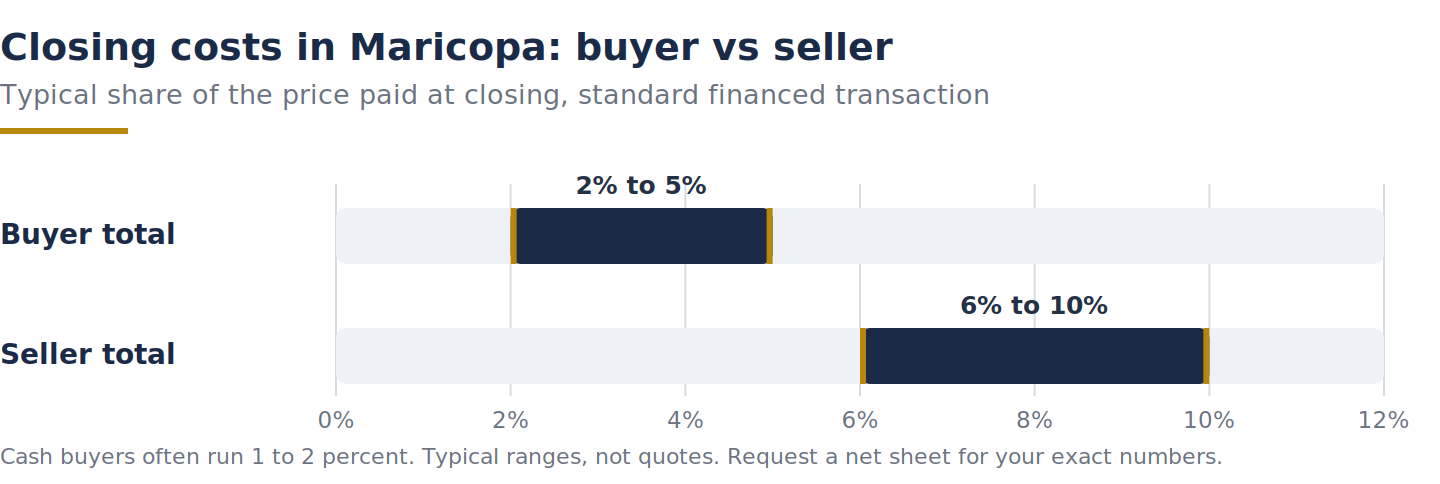
Closing costs at a glance: typical ranges

The following ranges reflect typical Maricopa, AZ, transaction prices as of publication. Your actual costs may run higher or lower depending on the variables noted in each section below.

  1. Buyer total. Typically, 2 to 5 percent of the purchase price is for a standard purchase with financing. Cash buyers run lower, often 1 to 2 percent. New construction buyers often run higher when builder incentives and design center adjustments are factored in.
  2. Seller total. Typically, 6 to 10 percent of the sale price. The largest component is the real estate commission. Title, escrow, prorations, HOA fees, and payoff charges make up most of the remainder.
  3. Earnest money. Paid at contract signing, not at closing. Typically, 1 percent of the purchase price in Maricopa is held by the title company and credited toward the buyer's closing costs.
  4. Appraisal. Paid by the buyer directly to the appraiser during the contract period, typically 600 to 800 dollars for a single-family home. Some VA and FHA appraisals run higher.

These are ranges, not promises. Reach out for a current-market net sheet tailored to your specific Maricopa address and price point.

What buyers pay at closing

Buyer closing costs in Maricopa fall into four categories: loan costs, title and escrow costs, prepaid items and reserves, and miscellaneous fees.

Loan costs (paid to the lender):

  1. Loan origination fee. Typically, 0.5 to 1 percent of the loan amount, sometimes higher on niche loan programs. Some lenders charge a flat fee instead.
  2. Discount points (optional). Prepaid interest to buy down the interest rate. Each point costs 1 percent of the loan amount and reduces the rate by a fraction of a percent.
  3. Underwriting, processing, and administrative fees. Typically, $500 to 1,500 dollars combined.
  4. Appraisal fee. Usually paid outside of closing, sometimes itemized at the closing table.
  5. Credit report fee. Typically, 50 to 150 dollars.
  6. Flood certification, tax service, and miscellaneous lender fees. Usually under 100 dollars combined.

Title and escrow costs (paid to the title company):

  1. Lender's title insurance policy. Paid by the buyer by Maricopa custom. The premium is set on a sliding scale based on the loan amount.
  2. Owner's title insurance policy. Paid by the seller by Maricopa custom, but the contract can shift this to the buyer in a competitive market.
  3. Escrow or settlement fee. Typically split between buyer and seller. Each side's share usually runs $ 350 to $ 600.
  4. Recording fees. Paid to Pinal County for recording the deed and deed of trust. Typically, $ 30 to $ 60 total.

Prepaid items and reserves (held by the lender for future bills):

  1. Prepaid interest. Interest from the closing date to the end of the closing month.
  2. Homeowners insurance. First-year premium paid up front, plus 2 to 3 months of premium held in the impound account.
  3. Property tax reserves. Several months' worth of property taxes are held in the impound account, depending on the closing date and the lender's collection schedule.
  4. HOA dues. Prorated through the end of the closing month.

Miscellaneous:

  1. HOA transfer fees. $ 200 to $ 500, paid to the HOA management company.
  2. HOA capital contribution or community enhancement fee, if any. Varies by community.
  3. Home warranty, if purchased. $ 500 to $ 800 for a one-year plan.
  4. Wire transfer fees. Usually under 50 dollars.

What sellers pay at closing

Seller closing costs are dominated by the real estate commission, but several other items add up. Here is the typical breakdown for a sale in Maricopa, AZ.

  1. Real estate commission. The largest single item. Commission rates are negotiable and vary by listing agreement. After the August 2024 NAR settlement, the listing-side and buyer-side compensation are negotiated separately and may be disclosed differently than in prior years. Confirm the current structure with your listing agent.
  2. Owner's title insurance policy. Paid by the seller to Maricopa custom. The premium is set on a sliding scale based on the sale price.
  3. Escrow or settlement fee. Seller's half, typically $ 350 to $ 600.
  4. Property tax proration. The seller credits the buyer for property taxes accrued but not yet due, since Pinal County bills in arrears.
  5. HOA dues proration. The seller pays HOA dues through the closing date. Any prepaid dues beyond closing are credited back.
  6. HOA transfer documentation fee. Some HOAs charge the seller for the resale disclosure package, often $ 200 to $ 400.
  7. Loan payoff and statement fees. If the home is mortgaged, the lender's payoff statement fee, reconveyance fee, and any prepayment interest are deducted from the proceeds.
  8. Courier, wire, and notary fees. Usually under 100 dollars combined.
  9. Repair credits, if negotiated. Any post-inspection credits to the buyer are deducted from the seller's proceeds.
  10. Home warranty, if offered to the buyer. 500 to 800 dollars.

Net proceeds are what is left after all of the above is deducted from the sale price and the existing mortgage payoff. Request a seller net sheet early in the listing process so you know your bottom line before the first offer comes in.

Title insurance in Arizona: how it works

Two title policies are typically issued in a Maricopa, AZ purchase. The lender's policy protects the mortgage company against ownership claims, liens, and recording errors that could affect the loan. The owner's policy protects the buyer against the same risks, for as long as the buyer owns the home.

By Maricopa-area custom, the buyer pays for the lender's policy, and the seller pays for the owner's policy. The purchase contract can change this allocation in either direction, and during competitive market cycles, buyers sometimes offer to pay for the owner's policy to make their offer more attractive to the seller.

Both policies are one-time premiums paid at closing. There are no monthly payments and no renewals. Premiums are filed with the Arizona Department of Insurance and Financial Institutions and are generally similar among title companies, though some companies offer reissue discounts when a recent prior policy is in place on the property.

Pinal County property tax prorations

Property taxes in Pinal County are billed in arrears in two installments each year. The first half, covering January through June, is due October 1 (delinquent after November 1). The second half, covering July through December, is due March 1 (delinquent after May 1).

Because taxes are billed after the period they cover, the seller has been living in the home and accruing tax liability for some number of days before closing without yet receiving a bill. At closing, the title company calculates the number of days the seller owned the home during the current tax period and credits the buyer for the seller's share of taxes. The buyer then pays the actual tax bill when it comes due.

A typical Maricopa, AZ, single-family home pays roughly $ 1,200 to $ 2,800 per year in property taxes, depending on assessed value, district, and any voter-approved overrides. Your title company's net sheet will show the exact proration based on the closing date. For tax questions specific to your situation, including any homeowner exemptions you may qualify for, consult a CPA or the Pinal County Assessor's office.

HOA transfer fees and capital contributions

Most established Maricopa subdivisions have an HOA, and HOA-related fees are reflected on both the buyer's and seller's sides at closing.

  1. HOA transfer fee. $ 200 to $ 500, paid by the buyer to the HOA management company to process the change of ownership and update the resident database.
  2. Resale disclosure package fee. 200 to 400 dollars, often charged to the seller for producing the required disclosure documents during escrow.
  3. Capital contribution or community enhancement fee. Some HOAs charge a one-time fee at closing to fund reserves or community improvements. Amounts vary widely by community, from 100 dollars to a full year of dues, and the fee is typically paid by the buyer.
  4. Dues proration. If the seller has paid HOA dues for a period that extends past closing, the buyer reimburses the seller at closing. If dues are due but unpaid, the seller pays them through escrow.

HOA documents are delivered to the buyer during escrow. Review them before contingencies expire so you have a clear picture of the monthly dues, any special assessments, and the rules governing the community. For neighborhood-specific HOA structures, see our pages on Maricopa neighborhoods when you are comparing communities.

Loan-related closing costs (buyer side)

Loan-related costs are the largest single category of buyer closing costs after the down payment. The specific items and amounts depend on the loan program.

Conventional loans. Typically, the lowest closing costs among standard programs. Lender fees are limited to origination, underwriting, processing, and credit report. Private mortgage insurance applies if the down payment is less than 20 percent and the first month's payment is collected at closing.

FHA loans. Include an upfront mortgage insurance premium of 1.75 percent of the loan amount, financed into the loan rather than paid at closing in cash. Monthly mortgage insurance also applies. FHA closing costs tend to be slightly higher than conventional because of the upfront premium and the additional documentation.

VA loans. Include a one-time VA funding fee that varies by service category and down payment, and is typically financed into the loan. Eligible disabled veterans are often exempt from the funding fee. VA loans also restrict which closing costs the buyer can pay, so the seller may cover items the buyer would otherwise pay for.

USDA Rural Development loans. Available for qualifying properties at the edges of Maricopa. Include an upfront guarantee fee and an annual fee paid monthly. Income and property eligibility apply.

Your lender will provide a Loan Estimate within three business days of your application. Compare Loan Estimates from at least two lenders before committing. Differences in lender fees and rate structure can move your closing costs by several thousand dollars on a typical Maricopa purchase.

Reducing closing costs on either side

Several legitimate strategies reduce closing costs for buyers and sellers in Maricopa.

Buyer strategies:

  1. Negotiate seller concessions. Ask the seller to pay part of your closing costs in the purchase contract. Each loan program caps the concession amount.
  2. Accept a lender credit. The lender pays part of your closing costs in exchange for a slightly higher interest rate. Useful if you plan to refinance or move within a few years.
  3. Compare the title and escrow providers. Buyer has the right to choose title and escrow in Arizona, though the lender may have approved provider requirements.
  4. Use a down payment assistance program. Several Arizona programs cover down payment and certain closing costs for qualifying buyers.
  5. Time the closing date. Closing late in the month reduces prepaid interest.

Seller strategies:

  1. Negotiate the listing-side commission. Commission is not fixed by law. Discuss the structure with your listing agent.
  2. Ask about reissue discounts on the owner's title policy. Available when a recent prior policy exists on the property.
  3. Time for the property tax cycle. Closing soon after a tax installment is due means the proration favors you.
  4. Limit repair credits. Address known issues before listing, so they do not become inspection negotiations later.
  5. Hold firm on the owner's title custom. In a balanced or seller's market, you can resist contract language that shifts the owner's policy to the buyer.

Estimating your closing costs before you sign

You can produce a reliable closing cost estimate before going under contract. Here is the order of operations.

  1. Get a Loan Estimate from your lender. Required by federal law within three business days of a formal loan application. Covers all loan-related costs and most third-party fees. Use the same lender for both Loan Estimates when comparing two lenders, so the comparison is apples-to-apples.
  2. Ask your real estate agent for a Maricopa-specific net sheet. The net sheet covers title, escrow, recording, HOA, and prorations based on the actual property and closing date.
  3. Add a buffer. Build in a few hundred dollars for items that move at the last minute, such as additional reserves or final HOA fees.
  4. Compare the Closing Disclosure to the Loan Estimate at closing. Federal law requires the Closing Disclosure to be delivered at least three business days before closing. Compare line by line. Question any change that you do not understand.

If you are early in the process and just want a ballpark figure, call 520-838-8037, and we can run quick numbers for any price point in Maricopa, AZ.

When to call a Maricopa real estate professional

Closing costs are easier to navigate with someone who has worked through hundreds of Maricopa transactions and knows the local title companies, HOAs, and contract conventions. Call The James Sanson Team if any of these apply.

  1. You are about to make or accept an offer and want to understand the financial implications before you sign.
  2. You are buying new construction and want a clear picture of what the builder is and is not paying, compared to the standard resale split.
  3. You are selling a home with an existing mortgage and want to know your net proceeds before listing.
  4. You are an out-of-state buyer or seller and want a walkthrough of how Arizona customs differ from those in your home state.
  5. You are comparing two Loan Estimates and want a second set of eyes on the closing cost lines.

Important. This page is informational, not tax or legal advice. Closing cost allocations, loan program rules, and tax treatment can change, and the figures above reflect typical ranges for Maricopa, AZ, as of publication. Confirm specific amounts with your lender, title company, and CPA. The James Sanson Team is not a tax advisor or attorney. For your specific situation, consult a CPA or an Arizona-licensed attorney. Call 520-838-8037 to talk through your transaction with a Maricopa specialist.

If you are buying or selling in Maricopa, AZ, and want a clear picture of closing costs before you sign anything, call 520-838-8037 to talk with a Maricopa-area REALTOR with over 23 years of Arizona licensure and 1,000+ closings.

Get matched with the right Maricopa specialist in 60 seconds

Tell us about your situation. We will connect you with whichever team member fits best. No pressure, no spam, just real help.

By submitting, you consent to be contacted by The James Sanson Team via phone, email, or text at the contact info you provide. Message and data rates may apply. Reply STOP to opt out.

FastExpert 2026 Top Agent RateMyAgent Price Expert Zillow Showcase Partner Licensed since 2002

Frequently asked questions

How much are closing costs in Maricopa AZ?
Buyer closing costs in Maricopa typically run 2 to 5 percent of the purchase price, depending on the loan type, lender fees, and the amount collected for tax and insurance reserves. Seller closing costs run roughly 6 to 10 percent, with the real estate commission accounting for the largest piece. Exact numbers vary by purchase price, loan program, title company, HOA, and contract terms. Ask your lender for a Loan Estimate and your title company for a buyer or seller net sheet to see your actual figures.
Who pays closing costs in Arizona, the buyer or the seller?
Both pay. In Arizona, the buyer and seller each have their own customary costs, and many items are split or negotiated in the purchase contract. Buyers usually carry loan-related costs, the lender's title policy, prepaid interest, and tax and insurance reserves. Sellers usually carry the real estate commission, the owner's title policy, and their share of prorated property taxes and HOA dues through closing. Contract terms can shift specific items, including seller concessions toward buyer costs.
Are closing costs negotiable in Maricopa?
Yes, many closing costs are negotiable. Sellers can offer concessions toward buyer closing costs, often capped by loan program guidelines. Buyers can ask for credits in the purchase contract or as part of inspection negotiations. Title and escrow fees can sometimes be reduced by selecting a different provider, though the choice may be limited by lender requirements. Talk with your agent about realistic negotiation strategies for the current Maricopa market before writing the offer.
Can a seller pay the buyer's closing costs?
Yes, sellers can pay part or all of a buyer's closing costs through seller concessions written into the purchase contract. Each loan program sets a cap. As of publication, conventional loans typically allow 3 to 9 percent, depending on down payment; FHA allows up to 6 percent; VA allows up to 4 percent in concessions, plus standard buyer-side items the lender restricts; and USDA allows up to 6 percent. Confirm current caps with your lender before structuring the offer.
What is title insurance and who pays for it in Arizona?
Title insurance protects against ownership disputes, liens, and recording errors discovered after closing. Two policies are typically issued in an Arizona sale: a lender's policy that protects the mortgage company and an owner's policy that protects you. By Maricopa-area custom, the buyer pays for the lender's policy, and the seller pays for the owner's policy, though the purchase contract can change this allocation. The owner's policy is a one-time premium that protects you for as long as you own the home.
How are property taxes handled at closing in Pinal County?
Pinal County property taxes are billed in arrears and paid in two installments each year. At closing, the title company prorates taxes between the buyer and seller based on the closing date, so each party pays only for the days they owned the home. The seller credits the buyer at closing for taxes that have accrued but are not yet due. Your title company's net sheet will show the exact proration. Consult a CPA or tax professional for questions about your specific tax situation.
What does it cost to transfer an HOA in Maricopa?
HOA transfer fees in Maricopa subdivisions typically range from $ 200 to $ 500, charged by the management company to process the change of ownership and provide required disclosures. Some HOAs also charge a one-time capital contribution or community enhancement fee, often equal to a quarter or a full year of dues, which the buyer pays at closing. Both fees are disclosed in the HOA documents that the seller delivers during escrow. Review the HOA paperwork carefully before contingencies expire.
When do I pay closing costs?
Closing costs are paid at the closing table, typically by wire transfer or cashier's check to the title company a day or two before recording. Buyers often pay an earnest money deposit at contract signing, a separate appraisal fee directly to the appraiser, and a home inspection fee directly to the inspector during the inspection period. The remaining closing costs and the down payment come due at closing. Your title company will send wiring instructions in advance, and you should verify wire details by phone.
Can I roll closing costs into my mortgage?
Sometimes. On a purchase loan, you generally cannot finance your closing costs into the mortgage on top of the purchase price, because the loan is limited by the appraised value and program loan-to-value rules. You can ask the seller for concessions toward closing costs, you can accept a lender credit in exchange for a slightly higher interest rate, or you can use down payment assistance programs that cover certain costs. Your lender can model these options against your specific budget and loan program.
How can I estimate my closing costs before going under contract?
Ask your lender for a Loan Estimate based on a sample Maricopa purchase price and your loan program, and ask your real estate agent for a buyer or seller net sheet from a Maricopa title company. The Loan Estimate covers all loan-related costs and most third-party fees. The net sheet covers title, escrow, recording, prorations, and HOA fees. Together, they give a reliable estimate. Call 520-838-8037 for a referral to a Maricopa-area lender and title company.

Talk to a Maricopa specialist today

Whether you're buying, selling, or just exploring, call us. No obligation.

520-838-8037

James Sanson | Real Broker LLC | Licensed in Arizona

Ready to talk? Get matched with a Maricopa Realtor today

Call 520-838-8037 right now, or fill out the form and we will reach out within one business day.

By submitting, you consent to be contacted by The James Sanson Team via phone, email, or text at the contact info you provide. Message and data rates may apply. Reply STOP to opt out.