

James Sanson
Team Lead and Listing Agent
AZ License SA535310000
22+ years in Maricopa real estate. 1,300+ closings. Specializes in seller representation and complex transactions.
Relocating to Maricopa AZ means moving to a master-planned city in Pinal County, about 35 to 50 minutes south of the Phoenix metro, with new construction and resale homes.
James Sanson
Team Lead and Listing Agent
AZ License SA535310000
22+ years in Maricopa real estate. 1,300+ closings. Specializes in seller representation and complex transactions.

David Hoos
Buyer Specialist
AZ License SA685039000
7 years in Maricopa. Works with first-time buyers and relocating buyers. Patient, thorough, and answers the phone.

David Ruiz
Bilingual Buyer Specialist
AZ License SA681464000
Habla español. 8 years experience. Works with buyers in 85138 and 85139 across Maricopa, including first-time buyers and relocating buyers.
James Sanson | Real Broker | Licensed in Arizona
Maricopa, AZ, is a master-planned community in Pinal County, about 35 to 50 minutes south of the Phoenix metro area. Median resale price is around $322,450 for September 2026 closings, per ARMLS, well below most of the Phoenix metro and dramatically below California, Washington, and Colorado origin markets. The city is home to about 78,000 people (78,194 on July 1, 2025, per the Maricopa Association of Governments), has active new construction from major national builders, and offers a range of subdivisions in 85138 and 85139. James Sanson has closed 1,300+ transactions tracked on Zillow, David Hoos focuses on relocating buyers, and David Ruiz is a bilingual real estate agent in Maricopa for buyers who prefer Spanish. Call 520-838-8037 to set up a relocation consultation.
On this page
Maricopa is one of the fastest-growing cities in Arizona by percentage, and a significant share of that growth comes from out-of-state buyers. California, Washington, Colorado, and the Midwest are the most common states of origin. The pull is consistent: a relatively affordable housing market, master-planned communities with modern infrastructure, all-ages neighborhoods, and year-round warm weather.
This page covers the practical considerations for buyers relocating to Maricopa from elsewhere: where the city is located, how the cost-of-living math works compared to your origin market, what the climate and commute look like day-to-day, and how to make smart neighborhood decisions when you cannot tour in person. To talk through your specific relocation, call 520-838-8037 and ask for David Hoos, who handles most of our relocation buyer transactions.
This is the single most common point of confusion among relocating buyers. The City of Maricopa is in Pinal County, Arizona. It is not in Maricopa County (which includes Phoenix, Mesa, Chandler, Scottsdale, Tempe, and Glendale). The two share a name but are completely separate places.
The practical implication: if your job, family, or social network is in central or north Phoenix metro, factor in a real commute. If your destination is the South Valley (Chandler, Gilbert, South Mesa), the commute is more manageable.
The reasons we hear most commonly from out-of-state buyers are ordered roughly by frequency:
Housing is the largest cost difference for most relocating households, so start there. The Maricopa median resale price was around $322,450 for September 2026 closings, per ARMLS. Pull the same figure for the market you are leaving from its local MLS or market report, and compare like for like: the same month, resale homes, similar size. How the gap usually looks by origin market:
Beyond home prices, taxes depend on your income and the state you are leaving, so take that comparison to a CPA. Vehicle registration fees and utilities (electricity is the most significant in Arizona) are real costs to budget for. Our new resident checklist walks through utility setup, vehicle registration, and the other first-week tasks.
The honest version of what life in Maricopa is actually like, day to day:
One thing to note: State Route 347 (John Wayne Parkway) is the main route north to Interstate 10 and the Phoenix metro. Through town it is a multi-lane divided parkway, not a two-lane road. The constrained stretch is the corridor between the city and I-10, which ADOT is now improving in phases. Crews are currently repaving the existing lanes for a smoother surface, which causes some delays outside of rush hour. The larger phase adds a third lane in each direction and new grade-separated interchanges along the corridor. It will speed up the drive long term but brings its own construction delays first, with completion targeted for the end of 2029.
On trains: the major mainline crossing was grade-separated by the John Wayne Parkway overpass years ago, so the old citywide wait for a freight train is gone. One at-grade freight crossing still remains, near the Walmart by the Santa Rosa communities, so a short wait can still happen at that one spot. See the full commute breakdown for current drive times and construction updates.
One honest local note that rarely makes a listing: Maricopa sits near working farmland and dairy operations, and on certain days, usually when the wind comes from a particular direction, there is a noticeable farm or feedlot odor in parts of town. It is periodic, not constant, and it bothers some people more than others. Drive the specific neighborhood at a few different times before you commit, the same way you would test the commute.
One thing that catches almost everyone moving from a larger metro: there is no single municipal utility bill in Maricopa. The city does not bill for power, water, or trash. Electricity, water and sewer, trash, internet, and gas where it reaches the address are five separate accounts with five separate companies, and two of them change depending on which subdivision you buy in. Before you set a move-in date, check which utility companies serve Maricopa so nothing is scheduled on an assumption. For the account-by-account order and deposit rules, see the step by step utility setup timeline.
For anyone working from home, fiber internet, branded Quantum Fiber, now reaches much of the city, though not every block, so confirm it at the exact address.
The eight major Maricopa subdivisions vary substantially in price, amenities, HOA structure, and school boundary. Quick orientation:
For relocating buyers, the right call often depends on three variables: commute target (which direction will you drive most often), school priority (some buyers care about specific school boundaries), and amenity preference (golf course, 55+ programming, lake walks, low HOA, etc.). David runs through these in the first relocation consultation.
If you would rather orient by zip code than by community name, the eastern side is the larger of the two. See current 85138 real estate listings.
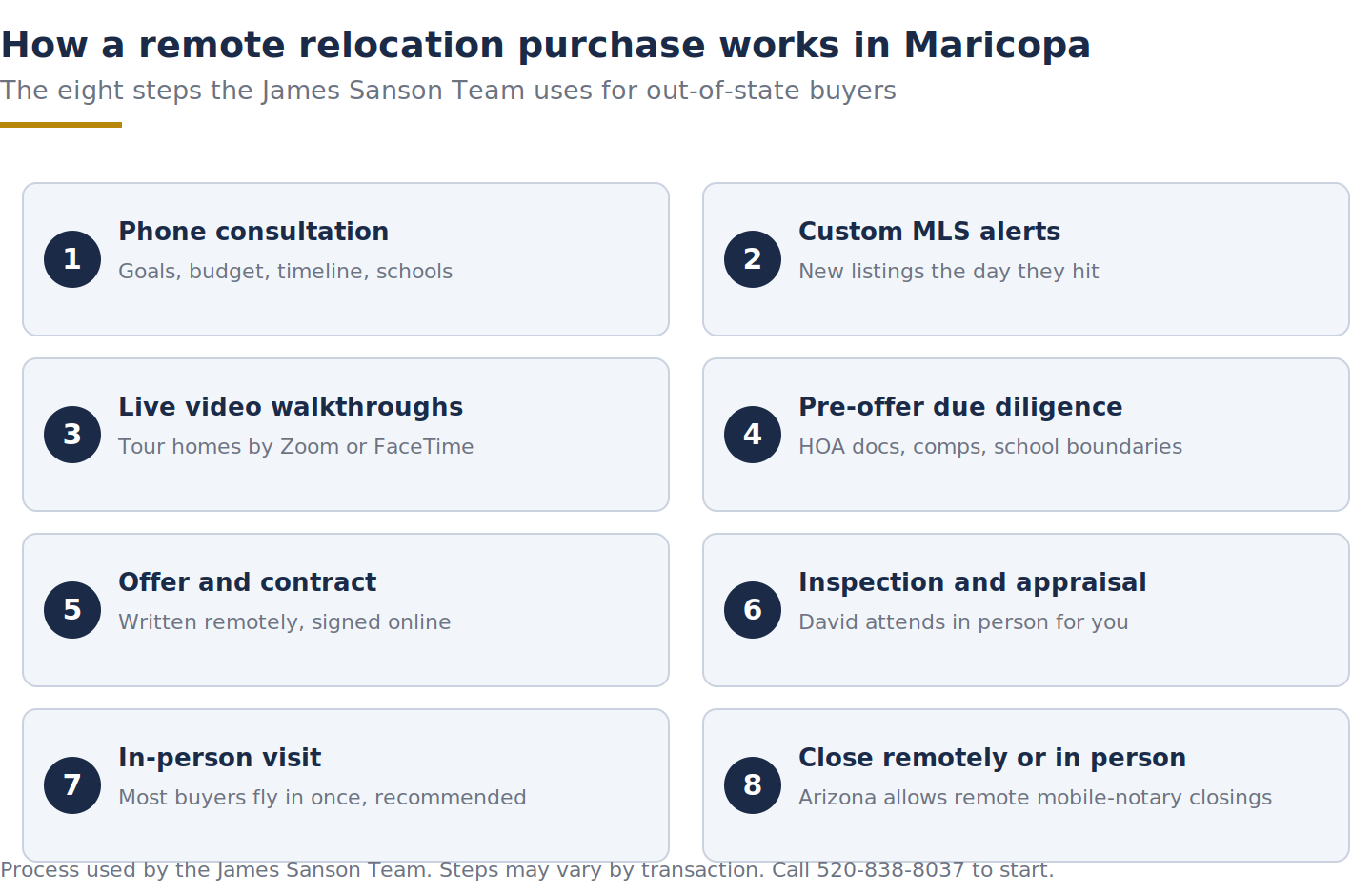
Out-of-state buyers can complete a Maricopa purchase remotely in eight steps, from a phone consultation and live video tours to a remote closing. Call 520-838-8037 to start your relocation search.
Most relocating buyers cannot tour in person every Maricopa home that interests them. The team works with relocating buyers regularly and runs a process built for distance:
Patterns we see repeatedly:
Maricopa is the right answer for many relocating buyers, but not all. Honest trade-offs versus alternative Arizona markets you might be comparing:
If your priorities are price, a modern home, a master-planned community, and settled subdivision living, Maricopa is often the right answer. If your priorities are urban amenities, shorter commutes, or cooler summers, other Arizona markets may be a better fit. David and James have been honest about this with hundreds of relocating buyers, including telling some of them that we are not the right team for their situation.
If you are relocating to Arizona and considering Maricopa, call 520-838-8037 and ask for David Hoos. The first relocation consultation is free and no obligation, and we will tell you honestly whether Maricopa fits your situation or another Arizona market would serve you better. For the full James Sanson Team background, or to read more about our buyer representation, those pages cover the rest.
If the move brings more than one generation, multigen floor plans in Maricopa explains what to look for. If a move into Maricopa also means selling a home here, talk through your sale and timeline before you set your dates.
Tell us about your situation. We will connect you with whichever team member fits best. No pressure, no spam, just real help.
Three specialists, one mission: help you buy or sell in Maricopa with confidence.
Team Lead and Listing Agent
AZ License SA535310000
22+ years in Maricopa real estate. 1,300+ closings. Specializes in seller representation and complex transactions.
Buyer Specialist
AZ License SA685039000
7 years in Maricopa. Works with first-time buyers and relocating buyers. Patient, thorough, and answers the phone.
Bilingual Buyer Specialist
AZ License SA681464000
Habla español. 8 years experience. Works with buyers in 85138 and 85139 across Maricopa, including first-time buyers and relocating buyers.
Whether you're buying, selling, or just exploring, call us. No obligation.
5.0 average across 267 client reviews on Zillow, as of October 2026.
520-838-8037James Sanson | Real Broker | Licensed in Arizona
Call 520-838-8037 right now, or fill out the form. We aim to respond within the hour during business hours.